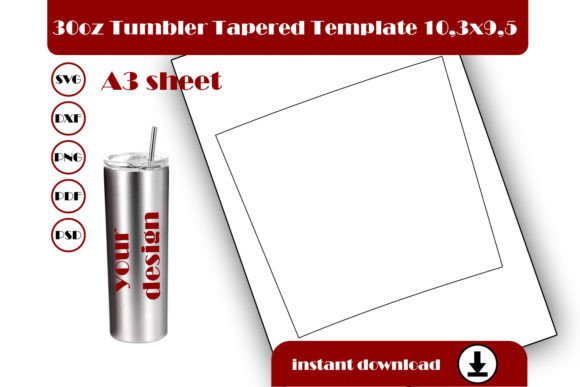
30oz Tumbler Tapered Template
A Blank Canvas That Actually Fits—Not Just Another Print Template
As someone who’s stitched hundreds of custom orders—from baby onesies for boutique clients to limited-run aprons for coffee shops—I treat every template like a potential collaborator. Not all blank layouts earn that trust. The 30oz Tumbler Tapered Template does. Its 10.3×9.5” dimensions aren’t arbitrary; they mirror the real-world curve and taper of a popular 30oz insulated tumbler. That means less guesswork when prepping a printable mockup, and more confidence when positioning an embroidered patch or heat-transfer design on a finished product.
First Impression: Clean, Purposeful, Uncluttered
This isn’t a graphic with built-in motifs or forced branding—it’s a graphics asset designed for makers who value control. Opening the included .PSD and .SV files, I immediately noticed how the tapered shape flows from top to bottom without awkward distortion. No stretched corners, no compressed lettering zones, no hidden raster layers muddying the vector path. It feels intentional—not just scaled, but shaped. That matters when you’re designing for embroidery, where stitch density and fabric drape interact with geometry in real time.
Where This Template Earns Its Keep in Real Projects
Last week, I used the 30oz Tumbler Tapered Template to develop a holiday-themed embroidered tote bag for a local gift shop. The taper guided my layout so the central monogram sat naturally above the base curve—no floating, no visual “sliding.” When stitched onto medium-weight canvas with a light tear-away stabilizer, the design held crisp lines without puckering. It worked equally well as a printable mockup for the shop’s Etsy listing and as the foundation for a final machine embroidery design on the actual tote.
It’s also become my go-to for small-batch embroidered patch development. Because the shape mirrors real tumbler curvature, I can test how satin-stitched borders behave along the angled edges before cutting fabric. On sweatshirt embroidery? It helps me visualize where fill stitch density might shift across the taper—critical for avoiding thread buildup near the base.
Use With Care: Where the Taper Asks for Attention
The beauty of this template is also its quiet challenge: because it’s tapered, not rectangular, small details near the top or bottom edges need extra scrutiny. Tiny lettering under 8pt? Test it on scrap fabric first—especially if you’re planning running stitch outlines or fine decorative accents. On stretchy fabric like cotton-spandex blends, the taper means tension shifts across the hoop; always use cut-away stabilizer and avoid dense fill areas near the narrowest points.
Dark fabric demands contrast checks early—run a black-and-white mockup to confirm legibility before stitching. And for curved surfaces like caps or tapered mugs (yes, some crafters embroider directly onto ceramic-coated blanks), remember: this template maps flat space, not 3D wrap. You’ll still need to adjust stitch angles manually—but having the correct 2D footprint saves hours of trial and error.
Why It Builds Trust—Not Just Aesthetics
Customers notice when personalization feels considered, not slapped on. A design placed using the 30oz Tumbler Tapered Template reads as intentional: the proportions align with how the eye travels across the object, the spacing respects the product’s functional shape, and the result feels like a handmade product, not a generic overlay. That nuance elevates perceived value—whether it’s a $45 personalized baby blanket or a $125 wedding gift set.
For Etsy sellers and small shop owners, that translates to better conversion and fewer “Does this fit my tumbler?” questions. For craft fair vendors, it means cleaner booth displays and faster client approvals—because your mockups look like real products, not placeholder art.
Practical Designer Notes Before You Stitch
- Always test on scrap fabric first—especially with textured or thin fabrics where taper distortion is harder to predict.
- Review stitch density across the full height: the narrower top may need reduced fill coverage to prevent stiffness.
- Confirm your hoop size accommodates the full 10.3×9.5” area—or plan for re-hooping mid-design if working on smaller frames.
- Inspect small details at 200% zoom in your editing software: corners, curves, and transitions should remain smooth in both .PSD and .SV versions.
- Compare how your thread colors read against light and dark backgrounds—tapered shapes cast subtle shadows that affect contrast.
- Use proper stabilizer for your fabric type: cut-away for knits, tear-away for stable wovens, and fusible for lightweight linens.
- Verify licensing terms before selling finished items or reselling digital assets—this Print Templates file includes no logo or image, but commercial use rights must be confirmed with the source.
Final Thought: A Tool That Respects Your Time—and Your Craft
The 30oz Tumbler Tapered Template doesn’t shout. It doesn’t come with presets or forced themes. What it offers instead is rare in digital design assets: fidelity to real-world objects, flexibility for multiple applications, and quiet reliability across embroidery project types—from baby embroidery to holiday embroidery to boutique branding. It’s the kind of digital embroidery file that disappears into your workflow, letting your creativity—and your customer’s experience—take center stage. If you sell custom apparel, run a craft business, or simply refuse to waste thread on poorly mapped layouts, this template earns its place in your library.