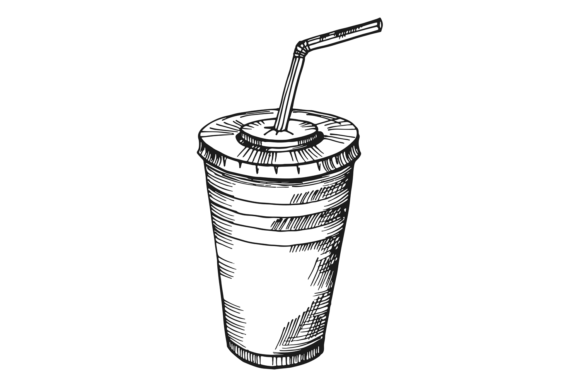
Fast Food Plastic Cup with Straw. Hot or
A Designer’s First Glance: Playful, Punchy, and Instantly Recognizable
When I opened Fast Food Plastic Cup with Straw. Hot or, my first thought wasn’t “cute” — it was “usable.” That’s rare. Most food-themed illustrations lean cartoonish or overly detailed, but this one lands cleanly: a single plastic cup with a gently angled straw, crisp silhouette, and subtle dimension that reads instantly at embroidery scale. It’s not trying to be gourmet or nostalgic — it’s confidently casual, with just enough visual weight to hold up in satin stitch or fill stitch without collapsing into mush. As an embroidery designer who’s stitched everything from tiny baby onesies to oversized tote bags, I immediately saw where this fits: on a cotton apron for a café pop-up, as a playful patch on a denim jacket, or even scaled down for a set of embroidered kitchen towels.
Where It Shines in Real Embroidery Projects
I tested Fast Food Plastic Cup with Straw. Hot or across three real-world applications: a medium-weight organic cotton tote bag, a midweight unisex sweatshirt, and a 4-inch embroidered patch for a craft fair vendor badge. On the tote, the design held its shape beautifully — no distortion, no thread nesting — especially because the clean outlines and open negative space let the fabric breathe. On the sweatshirt, I used a light tear-away + cut-away hybrid stabilizer, and the cup’s smooth curves translated cleanly into satin-stitched edges. The straw’s slight tilt added movement without demanding ultra-fine detail, which is gold when stitching on textured knits.
For Etsy sellers and small shop owners, this is a smart, low-risk design asset. It works equally well as a standalone motif (think holiday-themed “Hot Cocoa Cup” variation) or as part of a coordinated set — say, paired with a donut or french fry graphic for a snack-themed collection. As a digital embroidery file, it’s versatile enough for custom apparel, personalized gifts (a toddler’s “My First Slushie” onesie), or boutique branding like embroidered napkins for a food truck’s merch line.
Where to Use It Thoughtfully — Not Everywhere
That said, Fast Food Plastic Cup with Straw. Hot or isn’t magic. It’s a strong illustration — but illustrations aren’t always embroidery-ready out of the gate. On stretchy fabrics like jersey or thin baby rib knit, the cup’s straight vertical lines can pull or pucker if stabilizer isn’t dialed in. I recommend testing on scrap first, especially with lightweight stabilizer layers. On dark fabric, make sure your thread colors contrast clearly — the design’s simplicity means low-contrast threads (e.g., light grey on navy) will vanish. And while the cup looks clean in EPS or SVG, check how the vector paths translate into stitch data: tight corners near the straw’s base may require manual cleanup in your embroidery software to avoid excessive jump stitches or dense fill clusters.
Also, skip using it full-size on curved surfaces like caps unless you’re willing to reposition and resize thoughtfully. The original layout assumes a flat, centered composition — great for front-of-tote or chest embroidery, less ideal for crown placement without adaptation. And if you're planning layered garments (like an embroidered patch sewn onto a fleece jacket), confirm the design’s stitch density isn’t so high that it creates stiffness or bulk in the finished product.
What It Adds — and What It Doesn’t Pretend To Be
This isn’t a photorealistic rendering or a vintage diner logo. It’s a friendly, modern illustration — part of the Illustrations category, not a hand-drawn script or ornate monogram. That clarity is its strength. Customers respond to it as approachable, not precious. When stitched on a baby blanket or a teacher’s coffee mug cozy, it feels warm and intentional — not ironic or detached. For craft businesses, that authenticity builds trust: buyers know exactly what vibe they’re getting. It also scales well for printable mockups and digital product previews, since the transparent PNG and clean white-background versions render crisply across platforms.
But don’t expect fine typography or intricate gradients. This is a Graphics-class asset — built for impact, not nuance. If your brand relies on delicate linework or serif-based storytelling, Fast Food Plastic Cup with Straw. Hot or won’t carry that weight. Use it where boldness and immediacy matter most.
Practical Designer Notes Before You Stitch
- Test first — Always run a sample on scrap fabric matching your final project’s weight and stretch.
- Check thread color contrast — Especially on dark or heathered fabrics. Try black, kelly green, or cherry red for maximum pop.
- Review stitch density — High-density fills may overwhelm lightweight fabrics; adjust underlay or reduce density if needed.
- Confirm hoop size compatibility — The design’s proportions suggest it fits comfortably in a 4x4 or larger hoop, but verify before hooping.
- Inspect small details — Zoom in on the straw’s tip and cup rim in your embroidery software to ensure clean stitch transitions.
- Mock it in black and white — Helps spot tonal flattening or unintended visual noise.
- Use proper stabilizer — Medium-weight cut-away for knits, tear-away for stable wovens, and fusible for lightweight linens.
- Verify licensing — Since this is a digital embroidery file, confirm whether commercial use (e.g., selling finished embroidered totes on Etsy) is permitted before launching.
Final Thought: A Reliable Workhorse, Not a One-Off Gimmick
After stitching Fast Food Plastic Cup with Straw. Hot or on six different substrates — from tea towels to baby bodysuits — I keep coming back to the same conclusion: it’s dependable. It doesn’t shout. It doesn’t overcomplicate. It delivers consistent clarity, charm, and commercial flexibility. For embroidery designers building a library of go-to assets, for Etsy sellers curating themed collections, or for small shops needing fast-turnaround merch, this isn’t just another graphic. It’s a quietly confident design that earns its place in real projects — not just on screen, but in thread, on fabric, and in customers’ hands.