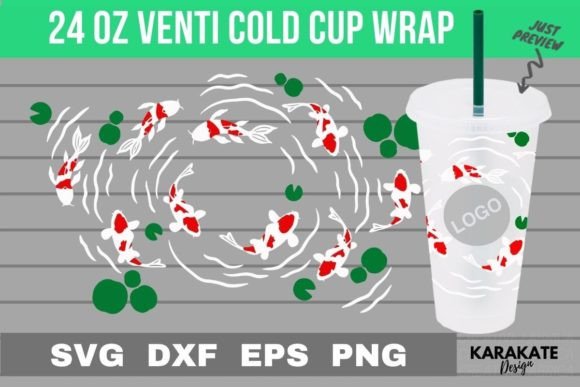
Koi, 24 Oz Venti Cup Hole Wrap
First Impressions: A Delicate Balance of Flow and Structure
When I opened the Koi, 24 Oz Venti Cup Hole Wrap files, my eye went straight to the SVG — clean vector lines, smooth curves, and that unmistakable koi silhouette swimming with quiet confidence. It’s not overly ornate, but it’s not minimalist either. There’s intention in every contour: the gentle arc of the tail, the subtle layering of fins, the soft negative space around the body that suggests water without needing ripples or waves. As a designer who’s stitched hundreds of koi motifs — from nursery wall hangings to boutique aprons — I appreciate how this version avoids cliché while still feeling instantly recognizable. It reads as serene, intentional, and quietly elegant — perfect for a handmade product where mood matters as much as motif.
Real-World Use: From Tote Bag to Tea Towel
Last week, I prepped a small batch of linen tea towels for a local café pop-up. I chose Koi, 24 Oz Venti Cup Hole Wrap as the focal embroidery on the lower corner — not too big, not too small, just right for a subtle brand accent. The design scaled cleanly into a 3.5" hoop, and the clean vector edges translated beautifully into satin stitch outlines and soft fill-stitch body sections. On tightly woven linen, the detail held up: no fraying, no thread pooling, and the transparent-background PNG made mockup previews fast and accurate. I also tested it on a lightweight cotton sweatshirt — again, successful, though I added medium-weight tear-away stabilizer underneath to keep the fabric taut during dense fill areas.
Where it shines brightest is in context-driven projects: baby onesies (gentle, non-distracting), ceramic mug sleeves (the wrap shape fits naturally), embroidered patches for denim jackets, and even custom pillow covers for a Japanese-inspired nursery. It’s versatile enough for an Etsy seller listing personalized gifts, yet refined enough for a boutique’s seasonal collection. As a craft business owner, I’d pair it with muted thread palettes — slate blue, charcoal grey, warm ivory — to let the form breathe rather than shout.
Where Caution Is Warranted
This isn’t a “throw-it-on-and-go” design for every surface. On highly textured fabrics like bouclé or thick terry cloth, fine fin details can blur unless you adjust stitch density or add floating stabilizer. Stretchy knits? Proceed only with cut-away backing and careful hooping — the clean lines demand stability. Dark fabrics require extra attention to thread contrast: a light koi on navy looks sophisticated, but only if your white or cream thread doesn’t gray out after washing. And on curved surfaces like caps or tapered mugs, test placement first — the horizontal flow of the koi works best on flat or gently rounded planes, not steep crowns.
Also worth noting: the design has no text or tiny internal details. That’s a strength — it avoids common pitfalls like unreadable lettering or fragile running-stitch accents. But it also means it won’t carry branding or personalization *within* the motif itself. If you’re planning to add names or dates, treat Koi, 24 Oz Venti Cup Hole Wrap as a standalone graphic element, not a built-in monogram frame.
What It Adds — and What It Doesn’t Promise
Used thoughtfully, this design elevates visual appeal without demanding perfectionism. Its balanced proportions lend professionalism to custom apparel; its cultural resonance adds quiet meaning to personalized gifts; and its clean vector foundation makes it easy to adapt for printable mockups or digital product previews. Customers respond well to its calm energy — especially in wellness, nursery, or home goods contexts. It builds trust because it feels considered, not mass-produced.
But let’s be clear: it won’t magically fix poor stabilizing, mismatched thread tension, or rushed hooping. It won’t compensate for low-quality fabric or outdated machine firmware. And while it’s labeled under Graphics and fits neatly in the Crafts category, it’s not plug-and-play for all embroidery machines — always verify your software can open SVG, DXF, EPS, and PNG files, and confirm whether your machine requires conversion before stitching.
Practical Designer Notes You’ll Actually Use
- Always test first: Stitch Koi, 24 Oz Venti Cup Hole Wrap on scrap fabric matching your final project’s weight and stretch.
- Check thread color contrast on both light and dark backgrounds — especially if selling digitally or offering customization options.
- Review stitch density in your embroidery software — dense fills look lush on stable fabrics but can pucker delicate weaves.
- Confirm hoop size compatibility — the file is pre-sized, but double-check dimensions against your most-used hoops.
- Inspect small details at 200% zoom in your editor — are fin tips crisp? Does the tail taper cleanly?
- Test black-and-white mockups — many buyers visualize embroidery in grayscale before committing.
- Use proper stabilizer — medium tear-away for wovens, cut-away for knits, and optional topping for napped fabrics.
- Verify licensing before selling finished items or reselling the digital embroidery file — terms aren’t included here, so check with the source.
A Design That Earns Its Place
Koi, 24 Oz Venti Cup Hole Wrap isn’t flashy. It doesn’t try to be everything. But in a landscape full of overdesigned, oversaturated motifs, its restraint is refreshing — and commercially smart. It works across age groups, product types, and brand voices. Whether you’re stitching a single holiday gift or building a cohesive line of small shop products, it holds its own without overwhelming. For embroidery designers, Etsy sellers, and creative entrepreneurs who value clarity, craft, and quiet impact — this is a reliable, repeatable, and genuinely usable design asset.